Sunday, August 25, 2013

A Decision Support System (DSS) Is Only As Good As the Principles it Rides On

One can argue that laws and regulations are enough to induce ethical and moral decision making. But just like having a police force doesn't alleviate crime. Having business regulations do not ensure that businesses will conduct their affairs ethically. Regulatory drivers alone are not sufficient to safeguard public interest from the ill affect of greed and unethical corporate behavior.  In the absence of a universal guiding mechanism for organizational ethical decision-making, corporations have no reservations about flooding the markets with contaminated food, tainted merchandise, or sub-prime mortgages.

Islamic traditional thought and philosophy has always been a proponent of financial profits with restrain on wasteful use of resources; of outward ambition with introspect and inner reflection; of economic growth with respect of laws of the land, and the laws of nature.

So can Islam offer a universal ethical Decision Support System?

The answer is, absolutely! 

Islam prescribes certain specific guidelines for the governance of business based on the legality of transactions, as per Islamic jurisprudence (fiqh) of lawful (halal) and unlawful (haram) activities. It identifies ethically desirable forms of business, specifies the undesirable modes of transactions and enumerates the general moral and ethical rules of business conduct (Mohammed, 2007).   

The essence of such a system will be based not on the short term goal of serving the self interest of selected individuals but on the long term goal of service to humanity with the ability of the system to induce a God-Conscious mindset for upholding universal ethical principles.  God-consciousness therefore will play a central role in the calibration of strategic decision making processes.   

A Code of Ethics based on this Islamic Decision Support System (IDSS) would therefore need to have the following injunctions:

Engagements must be lawful:  The IDSS code of ethics must mandate lawfulness ahead of goodness.  It also forbids the restriction of consumption of the lawful without a valid reason.

Human life must be safeguarded: The IDSS code of ethics must prohibit the loss of life at any cost from all forms of destruction, providing the framework for managing all human relationships (labor, workforce, vendor, customers, community at large, etc.) 

Human intellect must be protected and nurtured: The IDSS code of ethics must prohibit exploitation and forced buyouts safeguarding intellectual capital (copyright, trademarks, patents, intellectual property, etc.)

Decisions must factor impact to future generations: The IDSS code of ethics must prohibit extraction/production/disposal that causes undue or excessive harm to resources. In situations where some harm is inevitable, a careful weighing of relative harms and benefits should be made. Furthermore, a party that may be harmed must be compensated, based on the cardinal rule in Islamic Law that harm must be removed or recompensed. (Badawi, date unknown)

Wealth must be protected and safeguarded: The IDSS code of ethics must prohibit excessive leveraging of assets. It encourages ethical competition and spending in moderation to encourage a free enterprise system and keep economic engines churning.   
When a corporate decision support system conforms to this type of code of ethics, the business outlook will transform from stakeholder-consciousness to God-Consciousness. The strategy no longer will be focused exclusively on financial profitability, but rather on equity and fairness.  As the organizational psyche, thoughts, and behaviors are aligned with a God-centric sense of purpose, the organizational decision-making will take on a more long-term holistic perspective.  With this type of purposeful thinking we start to look at the cause and affect of our intentions and actions from a holistic perspective.  This kind of adjustment allows its practitioners a higher form of wisdom; a form of wisdom where they take on the responsibility of exhibiting trusteeship, accountability and transparency while demonstrating commitment, equity and excellence. 

The concepts of trusteeship, accountability, transparency are universal principles and are used to describe a God-Conscious individual in the Quran in many places.  The Quran also mandates all God-Conscious individuals to uphold their commitments, treat all with equality and demonstrate excellence in all endeavors.  

So what would core attributes of an IDSS be?

IDSS Attributes
Relevance
Trusteeship (Amanah): the understanding that resources are a trust from God and we bear responsibility in our utilization of them.
Efficient and effective deployment and utilization of organizational and natural resources to minimize wastefulness. 

Accountability (Hesab): the understanding that we are all accountable for our actions to God.

Adherence to laws, regulations, standards, and best practices pertaining to assigned duties and tasks.

Transparency (Gharar): the understanding that there are no actions or intensions, in private or in public, that are hidden from God.

Honest disclosure of information to public or private entities with respect to fiduciary and social responsibilities in a comprehensive, accessible, and timely manner.

Commitment (Aqd): the understanding that honoring of all obligations is a divine obligation.

Upholding and fulfilling all contractual agreements with all stakeholders; employees, unions, investors, suppliers, customers, partners etc.

Excellence (Ihsan): the understanding that God has ordained excellence in everything. (Badawi, date unknown)

Commitment to quality management frameworks with continuous improvement cycles effecting all aspects of the organization; health and safety, environmental protection, security, customer satisfaction, etc.

Equity (Adl): the understanding that our inner intentions and feelings should be consistent with our declared words and actions.

Fairness in maintaining a free enterprise system of trade and commerce without insider trading, political lobbying, revolving door hiring policies,  excessive executives compensation etc.  

Enabling IDSS philosophy is therefore a dynamic balancing act; aligning our thoughts and intentions with our deeds and actions in such a way that we retain God-Consciousness at all times in decision making. That maintenance of balance, in everything we do inwardly or outwardly, is not a mere recommendation but a divine order as the Quran states:
“And the heaven He raised and imposed the balance. That you not transgress within the balance. And establish weight in justice and do not make deficient the balance.” (Quran 55:7-9)


Sunday, January 20, 2013

Philosophy of Change


In a healthy person, the blood that leaves the heart is fully oxygenated. Medical science tells us that oxygen is important for our brains; lack of it causes bad memory, imbalance and lack of concentration. If Islam is to our conscience what oxygen is to our brain, every Muslim ideally should posses a healthy state of mind (guided by an enlightened soul in a state of God consciousness).  That elevated state of mind, then should translate into an invigorated sense of purpose in life, positively affecting the human development project.

So the question then arises, how come the hearts and minds of Muslims are in such a depleted state of affairs? Where are Muslims who can reflect and understand? A quick cursory analysis of the Human Development Index (HDI) reveals that the majority of Muslim countries lag behind the rest of the world in socio-economic development.

Civilized Muslim societies, given the absence of honor, respect, dignity, social mercy and tolerance, are like the endangered species that are rapidly racing towards extinction.  We have contaminated our environmental ecosystem with waste and pollution. We have contaminated our social ecosystem with prejudice and injustice. We have contaminated our economic ecosystem with corruption and greed.  We have contaminated our spiritual ecosystem by submitting to our low base desires instead of submitting to God. Void of any accountability, we are insensitive to the consequences of our actions. Void of responsibility, we have lost our sense of purpose.  And void of self reflection, we have lost the ability to change. 

Clearly one cannot deny the emphasis Islam places on incremental continuous improvement to bring about positive change in the status quo.  Islam not just demands a change for the better when it comes to our hearts and minds, but it also mandates change in our behavior and in our attitudes.  Behavior equals thought plus action (behavior = thought + action). Any behavior void of thought is nothing but a mere habit.  Habit is normally defined as a recurrent, often unconscious pattern of behavior.   If actions are judged by intentions, as per the hadith of the holy Prophet (may peace be upon him), then our “thoughts” are the drivers for our behavior. Acting mindlessly without the use of intellect is not akin to emulating prophetic behavior. 

13:11 Verily never will Allah change the condition of a people until they change it themselves (with their own souls).

Every conscientious Muslim bears the responsibility to figure out what we have done to be in this depleted state of affairs.  This responsibility starts with redefining our purpose in life.  Purpose is often confused with a goal.  But purpose is not the goal.  It leads one to the goal. Not everyone’s purpose in life is the same (i.e. not everyone is motivated by the same things in life).  And for each individual purpose changes as their life progresses. Therefore our purpose needs to be as dynamic as everything around us.   Anything that is dynamic in nature is in a perpetual state of change.  

So how do we kick start our own change process? As Muslims our goal is to submit whole heartedly to our Creator so that we can attain His love.   Submission is an active choice that requires inward reflection. Ability to reflect and understand comes from keen sense of connectivity with your Creator.  Connectivity creates the motivation to do whatever it takes to get to our goal. That motivation gives rise to a sense of purpose within us. Purpose creates the urge for self reflection and self analysis.  Self analysis is necessary for measuring our performance, in attaining the love of our Creator. And once we know where we stand, we make the commitment to improve.  That commitment to improving our performance is the energy we need to kick start change from within.   It is that type of energy that leads to success. 

24:55 Allah has promised those who have believed among you and done righteous deeds that He will surely grant them succession [to authority] upon the earth just as He granted it to those before them… 


Saturday, March 31, 2012

Inner Dimensions of Management

Ethical and moral tendencies are cultivated in individuals only when the ability to reflect inwardly in activated.  This ability to reflect inwardly is part of every human soul; God given.  Sound reasoning is a byproduct of balanced inward reflection. It is only achieved when our intellectual, emotional and physical psyche is balanced.  

The Quran, in numerous passages, invites its readers to reflect.  It is thought provoking reflection that connects us to our reflective tendencies.  The deeper the connection we have with our soul the more enriched we are with God-Consciousness.   The Quran describes three distinct states of the human soul and its effects on human behavior.

  • State of Heedlessness (Nafs al-Ammar): A soul that clings to materialistic low base desires. This is the stage where we are completely void of inner reflection.
  • State of Awareness (Nafs al-Lawwamah): A soul in the state of constant struggle against its material self, and
  • State of Contentment (Nafs al-Mutma’innah): A soul that reaches a state of peace due to constant God-consciousness.

The better we understand the human psyche as managers, the better we become at mastering the social science of management and at managing organizational affairs.

To understand the wisdom behind Islamic management principles, we must first understand the inner working of human psyche from a physical, emotional and intellectual perspective. One of the greatest Muslim theologian, jurist, philosopher, and mystic in Islamic history, Imam Al Ghazali, known as Algazel to the west, has written extensively about the inner working of the human psyche.  Al Ghazali identified three systems that encompass the human psyche; an Emotional system, a Behavioral system and a Cognitive system (Crook, 2008). 

All three systems are constantly in motion, similar to a pendulum depicted in the figure.  When Al Ghazali’s systems are integrated with the states of the human soul we begin to understand the various characteristics and personality traits within us that help define our inner reflective tendencies.


Heedlessness tends to push the pendulum away from its resting position disturbing the equilibrium state of our reasoning.  Awareness tends to pull the pendulum back to the resting position in an attempt to restore the equilibrium state of our reasoning.  Contentment tends to maintain the pendulum from wild swings in our reasoning thereby creating a sense of calmness within us.

The Emotional System
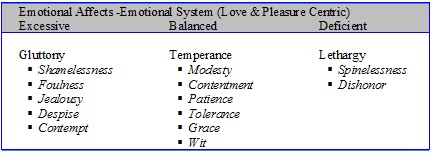
The Emotional system is where the desire for love and pleasure resides and is responsible for creating a range of inclinations for love and pleasure within us. A balanced and God-conscious Emotional system gives us temperance in the management of our affairs.  An imbalanced one gives us either gluttony on one extreme or lethargy on the other. The following table outlines the various effects of excessive, deficient or balanced psyche for the Emotional system.


Excessiveness within the Emotional system creates management systems that are driven by gluttony, where it is acceptable to make profits solely driven by greed.  The US sub-prime market crisis was a perfect example of this type of imbalance. Deficiency within the Emotional system creates management systems that are driven by lethargy where we continue to support bad decisions to maintain status quo. The US government bailout of financial institutes deemed too big to fail, in spite of evidence of gross negligence on their part, is a leading example of this type of imbalance.

The Behavioral System
The behavioral system is where our desire for anger and pain resides.  This system is responsible for creating a range of inclinations toward or away from anger and pain within us. A balanced, God-conscious, behavioral system gives us courage in the management of our affairs.  An imbalanced behavioral system gives us either reckless on one extreme or cowardice on the other. The following table outlines the various effects of excessive, deficient or balanced psyche for the Behavioral system.


Excessiveness within the Behavioral system creates management systems that are driven by recklessness, where negative consequences of behavior are completely ignored in order to meet shareholder expectations.  British Petroleum’s (BP) inability to heed the warning signs about safety and health issues at the Deepwater Horizon drilling rig is a great example of this type of imbalance where innocent lives were lost, the livelihood of thousands was destroyed, and ecosystems and tens of thousands of miles of coastline were damaged.

Similarly, deficiency within the Behavioral system creates management systems that are driven by cowardice, where decisions are made to correct present deficiencies at the expense of the future.   The reckless benchmarking practiced employed by many state and local public retirement fund managers that have allowed   public entities to draw on retirement funds inappropriately to fill budget gaps over the last decade, is a perfect example of this type of imbalance.

The Cognitive System
The cognitive system is where our desire for knowledge and reason resides.  This system is responsible for facilitating the ability to reason within us. A balanced, God-conscious, cognitive system gives us wisdom in the management of our affairs. An imbalanced cognitive system gives us either deception on one extreme or foolishness on the other.  The following table outlines the various effects of excessive, deficient or balanced psyche for the Cognitive system.


 Excessiveness within the Cognitive system creates management systems that are driven by deception, where roles, responsibilities, and information are misrepresented.  The revolving door recruitment polices between the enforcement arms of government and regulated entities on Wall Street are prime examples of this imbalance.  Deficiency within the Cognitive system creates management systems that are driven by foolishness, where common sense is abandoned in the everyday decision making processes.      

When we apply Ghazali’s theory to the collapsing economies, financial bailouts, status downgrades, and political/social unrest, we clearly see the imbalance of our collective human psyche, reflected in our societies. The gluttony that exists in our corporate world, the disparity of income between the rich and the poor, the amount of debt we carry, the armed conflicts we have created, the rate at which we are depleting our natural resources, are all clear signs of a deficient collective psyche.    How can the social science of Management be mastered with a deficient psyche?  The Quran states:
“…Surely, God does not change the state of a people until they change the state of their own souls…” (Quran: 13:11)
The fundamental concept of ethics and morality is pre-wired in all human beings.  It allows us to differentiate between good and bad, right and wrong, equality and injustice.  It all begins with the ability to reflect inward and continually manage the swinging of our psyche’s pendulum. Maintaining such inner balance requires a conscious and sustained effort.  This constant effort is considered the highest form of struggle (jihad) in Islam. It is this constant struggle that gives birth to God-consciousness.


Wednesday, April 13, 2011

An Imbalanced Pursuit of Happiness!

Just like individuals band together to create families and families come together to create societies, our collective conscience creates the conscience of the society we live in. Since our societies depict realities that stem from our collective conscience, it is important that our perception of those realities is firmly rooted in a moral and just socio-economic system. The realities that stemmed from the collective conscience of the founding fathers of our nation were once beautifully summed up in what we now know as the Declaration of Independence.

“…We hold these truths to be self-evident, that all men are created equal, that they are endowed by their Creator with certain unalienable Rights, that among these are Life, Liberty and the pursuit of Happiness…”
-Declaration of Independence, July 4, 1776

Today as I look at the state of affair of our union, I see a nation slowly drifting away from the foundational framework laid down by the founding fathers for the governance of our collective state of affairs. I see a free market enterprise system out of balance where statutory loopholes are frequently exploited to undermine fiduciary responsibilities. I see financial profitability playing a central role in guiding our decision-making processes. The unalienable right of life, liberty and pursuit of happiness has now become a privilege no longer for the masses.

Our poverty rate is now the third worst among the developed nations according to the Organisation for Economic Co-operation and Development (OECD). According to http://www.businessinsider.com/ , our nation’s household participation in the food stamp program has increased 20.28% since 2009; while one out of every seven mortgages in the United States was either delinquent or in foreclosure during the first quarter of 2010. In spite these alarming statistics of economic and social suffering of the masses, Wall Street paid a whopping $144 billion in compensation and benefits to its executives for 2010; a 4% increase from the $139 billion paid out in 2009. With homelessness growing at an alarming rate, healthcare costs skyrocketing and debt spiraling out of control, certainly we the masses are in pursuit of a very distorted reality of happiness.

If our individual consciousness is fueling our collective consciousness then it behooves us to closely examine our own selves to decipher the root cause of this socio-economic imbalance. A good point to start is a little bit of inward reflection. One of the greatest Sufi mystic poets from the region of Punjab in Pakistan, Bulleh Shah, talks about our struggles with this respect in many of his poems. I’ve tried translating a few lines from one of his poem: 

We're so occupied with attaining outward knowledge
That we never spent time knowing our souls
Our thoughts are shaped by externalities
Yet we never contemplate what the heart holds
We’ve reached the limitless skies
But we’ve failed to reach our heart’s inner folds
Inward reflection is the ability to self-monitor our own adherence to accountability, commitment and transparency with the filters of morality and ethical codes of conduct in our own lives. This type of self analysis is innate to the human souls who are mindful of the oath of conscience they took when they took on the responsibilities that came with the unalienable rights endowed to them by their Creator. Because with rights comes responsibilities. We have the right to make profit from our businesses, but we also have the responsibility to show restraint when it comes to wasteful use of our resources. We have the right to be ambitious and dream big, but we are also responsible for taking time for introspect and inner reflection. We have the right to grow and prosper, but we are also supposed to respect the laws of nature so that we don’t pillage and plunder. We have the right to improve our own material wellbeing, but we are also supposed to help the less fortunate and the needy.

Intrinsic to long term sustenance of our Declaration of Independence is the adherence to a balanced governance framework; a framework that is built on the pillars of accountability, commitment and transparency. Balance has to be the core component for universal governance of our affairs. It is this balance that in turn induces equitable and sustained prosperity. And this balance cannot be achieved unless we learn to reflect inwardly.

“Surely, God does not change the state of a people until they change the state of their own souls” (Qur’an 13:11).

Friday, January 28, 2011

This is About Internal Agitation


So in your face, obvious
That no one seems to care
Hollow molds of emptiness
No more hope left to share
Resurrecting from within
Rekindling the flare
Rise up O down trodden
Change the state of affair
Your revolution is waiting
There are responsibilities to bear
Let's take them on, one more time
With unison we declare
We'll fight for human dignity
To eradicate despair…

The agitation that started in Tunisia is now spreading to other parts of the Muslim world. This is no emotional outburst of uneducated masses caused by any external stimuli. This is not about demonizing the west. There is no US flag burning. There is no religiously motivated rhetoric behind the outrage. This is not even about demanding rights; I’m afraid that time is long gone! This is about hopelessness! This is about despair; despair that reaches deep down into the human psyche imploding the soul. People in the Muslim world have being oppressed for too long. The primary mode of oppression has almost always been this sleazy style of statesmanship; driven by greed; intoxicated with power; void of any conscience; hollow from within; self absorbed!

Of the world’s poorest nations, more than half are Muslim. Moreover, about 75% of refugees in the world today are Muslims, externally and internally displaced, due to wars, famine, and/or severe economic conditions. There is no sign of just governance of public affairs in many Muslim countries. There is no end to social inequities. Justice is for the wealthy. Punishment is for the weak. Such unhealthy conditions of social and economic imbalance, not only creates desperation but eventually fuels social destabilization and unrest ripping apart the very fabric that binds a society.

It is true that physical agitation is a manifestation of lack of basic civic necessities. But what we see today is not a result of physical agitation that can be controlled by force. Although many leaders in the Muslim world will resort to brutal force to suppress this uprising; a cowardly act indeed. In actuality this agitation is the agitation of the soul, especially Muslim youth, one that is fueled by the deprivation of human dignity. For it is true that these so called Muslim leaders, the whole lot of them, have done nothing but to deprive their people of basic human dignity.

It only starts as a whisper
That ignites a burning desire
They may fight the uprising
But they can’t put out the fire

Saturday, January 8, 2011

Synaptic Impulses

All human beings are endowed with certain capabilities that are God given innate to our souls. What we do with these capabilities in this life is up to us. We will be held accountable for them one day! Once we can understand that accountability in our everyday living, we go through a spiritual awakening.


This short book of poems is about my inward journey; my attempt to decipher the meaning of my life. My hope is that whoever reads it reflects upon their inner journey inculcating a desire to change for the better, rather than just cluttering their minds with yet another set of readings.

Get your copy today and start your own process of inner reflection!

May we all continue to read and learn new things in life that are beneficial to us and others around us and may we from the wisdom that we are given continue to uplift others in their thoughts and in their actions. Amen!

Wednesday, June 16, 2010

Organizational Governance

In a free market system corporate governance is generally a lagging influencer, meaning that we introduce rules and regulations after a negative event has already occurred. Our knee jerk reactions to unforeseen performance results almost always give rise to efforts for greater transparencies. Although greater transparencies may create short term performance correction, they seldom create accountabilities to the right entities. The concept of a balanced governance model is one which is built on the foundation of accountability not transparency. Because where accountabilities start transparencies begin.

Intrinsic to long term economic sustenance of any organization is the adherence to a balanced governance framework; a framework that is built on the pillars of accountability, commitment and transparency. Balance is core to universal governance laws. It is this balance that in turn induces sustained prosperity.

A balanced governance model is one where accountability, commitment and transparency are the foundation on which public trust responsibilities are shouldered. Responsibilities only to special interest groups leave other governance components either under utilized or over leveraged. Organizations often put financial performance ahead of all other performance parameters, creating imbalance in governance. In such one-dimensionally run organizations when the financial element weakens or buckles, the entire organization collapses instantly. Wonderment and unbelief follows as leaders and analyst are left dazed and confused only to blame their failure on external market economic forces.

Thursday, June 3, 2010

Organizational Learning a Bottoms Up Approach

I once asked a very successful business man whom I was working for, what is it that I can do to make you happy?

He said with a smile on his face, "Just excel in everything you do and never stop learning."

I did not understand what he meant back then, but he knew exactly what he was asking me to do.

Although my ability to excel and become successful within his organization did help me advance up the ranks, but it was my excelling that truly propelled his business forward. The lesson that I learned from that one little conversation has really come a long way in shaping my thoughts today about organizational learning strategies.

The success of any organization lies in the personal and professional growth that the lowest level member undertakes as part of his or her development cycle. Because if the organizational member at the bottom grows everyone on top rises.

Sunday, December 6, 2009

The MBI Framework
Life is based on a single set of directives –a divine manual called the Quran, for stipulating a code of submission; a code that applies evenly to all realms of our lives without distinction. So if Quran is that set of policy directives, the word of God Himself, then Prophet Muhammad’s character (May Peace and Blessing of God be with Him) is the behavioral manifestation of the word of God. Just as the Quran is a document perfect in its compilation and delivery, so is the character of the person who was charged with disseminating this information to mankind. Therefore, for a sincere Muslim, implementing the MBI framework should not be a foreign exercise.

The MBI framework is a pyramid with two halves, see figure below. The intellectual half signifies the Quran. The physical half signifies the way of the Prophet. The two halves are not mutually exclusive. One feeds the other. The intellectual realm has to be firmly rooted in the basic principles of the Islamic creed (Aqeeda). Similarly the physical realm needs to be in conformity with the Sunnah of the Prophet. Without this balanced approach the framework loses its essence.


The progress forward starts off with the willingness of an entity (individual or an organization) to acquire the right type and level of education coupled with measurable actions. Education as soon as it is acquired needs to be implemented. Education that is not implemented does not become knowledge. Therefore, the first step is attaining the right education followed by measurable action creating behavioral knowledge. Behavioral knowledge is applied hands on education; one that empowers. For without behavioral knowledge skillful understanding of any subject cannot be achieved. This skillful understanding helps in fueling our thought process and forces us to contemplate. In order to achieve mastery one has to spend time contemplating what they have learned, how they have applied it and what results they have achieved. This type of a comptemplative exercise forces us to improve our skill set. The mastery of skills and the ability to contemplate enables God consciousness. Only when one has achieve God consciousness through this process their persona becomes worthy of exemplification.

The MBI Roadmap
The journey from the base to the top of the pyramid requires implementing a five (5) step MBI roadmap. The starting point for implementing such a God-centric framework starts with the concept of SALAM©. SALAM© is an acronym that constitutes the building blocks for MBI. Each letter signifies a time tested corporate management dictum. Yet each dictum is filtered through the core fundamentals of spirituality and God consciousness.

The MBI Roadmap:
· Sense of Purpose
· Accepting the Framework
· Learning Organizational Wisdom
· Applying the Flexibility in Practice
· Mastering the Process

The following is a brief description of each MBI building block:

Sense of Purpose
And We did not create the heaven and the earth and that between them aimlessly… (Chapter Saad, Verse 27).

If there is a purpose for God’s creation of heaven and earth and everything in between, why shouldn’t there be purpose to what we do as human beings? Having a sense of direction is a vital component of success in the business world. Our bearings should be calibrated to the right course constantly; otherwise we may not reach our destination. A sense of purpose, the reason why, should therefore be the underlining cause for all actions that we undertake. The first building block for MBI is therefore our ability to have a sense of purpose. Purpose is the fuel that drives our engines. It is the reason why we do what we do. That is why in the corporate world everything is tied to goals, strategies, missions and visions. These are all tools for inducing a sense of purpose. The first step in MBI roadmap is defining our organizational goals and the goals of each of our members.

To each is a goal to which Allah turns him; then strive together (as in a race) towards all that is good. Where so ever ye are, Allah will bring you together. For Allah hath power over all things. (Chapter Al Baqarah, Verse 148)

Accepting the Framework
It is He Who sent down to thee (step by step), in truth, the Book, confirming what went before it; and He sent down the Law (of Moses) and the Gospel (of Jesus) before this, as a guide to mankind, and He sent down the criterion (of judgment between right and wrong). (Chapter Aali Imraan, Verse 3)

The analysis of any man made frameworks indicate an inherent inability to be proactively balanced in addressing all organizational goals. In other words, any man made framework is flawed and incomplete until it is infused with universal spiritual laws.

The second building block for MBI therefore is divided into two folds:
1) The degree of our acceptability of the divine operational framework, and
2) The skill with which it is applied as our guide for decision making processes.

Any process void of written procedures is random and arbitrary; because processes without procedures are an indication of absence of governance policies. Policies in turn are entrenched in principles. The principles, whether financial, administrative, or operational, are derivatives of spiritual fundamentals based on natural universal laws. Therefore a good indicator or an entity’s core not being guided by the MBI philosophy can be easily accessed by quickly looking at its procedural day-to-day running of its affairs.

Learning Organizational Wisdom
He grants wisdom to whom He pleases, and whoever is granted wisdom, he indeed is given a great good but none will grasp the Message but men of understanding. (Chapter Al Baqarah, Verse 269)


Once we have our goals set and our framework examined, the next step is to acquire the wisdom and intelligence to implement the framework. Since not everyone is endowed with wisdom, it is important to tap into individuals who posses this God given capability. Therefore acquiring wisdom and intelligence is a twofold process: 1) having people on our teams that have the right knowledge and experience, and 2) developing a keen sense of understanding of our roles and responsibilities.

People with understanding of the subject matter can guide us forward effectively. And having the correct understanding enables us to put the right actions into motion; actions that are mindful of our goals. The third building block of MBI, therefore, is our ability to learn the wisdom behind the key elements of the framework and their relationship to both our short range and long range goals. Benefiting from the collective wisdom of the organization and learning to manage the shared knowledge is vital to organizational success. Organizations without the ability to inculcate operational wisdom in their members lose their focus. Attaining organizational wisdom is learning how to harness the various elements of intelligence within the organizations.

These elements of intelligence are:

1. Personal Intelligence: The ability of the organization to enlist members who based on their individual aspirations synergize the organization’s goals and values
2. Group Intelligence: The ability of the organization to foster intelligent collaborations among its members.
3. Organizational Intelligence: The ability of organizational members to tap into their collective group intelligence enabling them to respond or adapt to the challenges by executing the right actions
4. Collective Organizational Wisdom: The ability of the organization to archive personal, group and organizational intelligence efficiently so that the collective wisdom can be documented for mentoring and training purposes.

Applying the Flexibility in Practice
(Such has been) the practice (approved) of Allah already in the past: no change wilt thou find in the practice (approved) of Allah. (Al Fath, Verse 23)

While natural law is perfect and does not require constant change, it is our way of implementing the natural law that is far from perfect and requires continuous realignment. A God-centric management approach is one that is accommodating to change in our attitudes and management styles.

The fourth building block of MBI is therefore, applying flexibility in practice. Flexibility in practice is having the courage to admit our mistakes, redress our wrongs and manage by consensus so that we can constantly realign our goals to prescribed natural laws. Another important element of applying flexibility is the ability to be accepting of different point-of-views, being non-judgmental and learning to work with a diversified set of individuals. When a goal is comprehensive enough to benefit everyone, then minor differences and disagreements should not be allowed to derail the forward movement towards that goal.

Mastering the Process
So lose not heart, nor fall into despair: For ye must gain mastery if ye are true in Faith.
(Aali Imraan, Verse 139)

Understanding the wisdom behind the framework enables an organization and its members to master the right skill set. Skills that are not based on collective organizational wisdom lead us off course. When our practice of fulfilling our duties and responsibilities is God conscious and our skills are based on collective organizational wisdom, we exhibit flexibility in our approach in resolving our challenges. This flexibility allows us to accept decent, respect alternate opinions and encourage diversity within our organizations. The fifth and final building block in MBI is therefore the mastering of the process.

Attaining mastery is no easy task. It is attained after much trials and tribulations. Hallmarks of entities that attain it are humility and reverence. Whether you are an organization of one or many, setbacks, economic downturns, competition and other environmental challenges never seize of exist. It is these challenges that make us and shape us. But if the basics are sound and the foundation is build upon core principles, the goal is alway in sight.

Mastery (Ihsan) is not only the combination of efficient process oriented approach in managing our programs with effective strategies aligned with the core principles of governance, it is also the ability to lead by example.

This is just my opinion based on my limited knowledge. God knows best!

Saturday, December 5, 2009

A Risk-based Submission Management Approach
Reactive ad hoc solutions just do not provide a strong enough systemic approach in mitigating risks. Risks can only be minimized if we have total understanding of our goals, our responsibilities and our duties to perform the task at hand. Only a well founded and properly implemented management approach can provide a measure of confidence that good performance is not an accident and that poor performance can be identified and rectified.

The degree of confidence in our ability to understand our goals and to monitor our performance is the key to forecasting success or failure. This is what Management by Islam (MBI) is all about -- a God-centric operational framework for adaptive risk mitigation. It is a frame of reference that is based on a balanced approach; combining corporate organizational management and development philosophies with a God-centric spiritual dimension. The better we manage our risk the better off we are in predicting the end result.

In absence of a framework for submission, conformance is arbitrary, accountability is non-enforceable and success or failure has no meaning. The Quran is, therefore, the policy document establishing the framework of submission. Just as the Quran is a document perfect in its compilation and delivery, so is the character of our beloved Prophet Muhammad (may peace and blessing of God be upon him) who was charged with disseminating this information to mankind. The Prophet’s life is the physical manifestation of the word of God. There is no doubt that everyone is created with the spirit and the understanding of following the divine set of guidelines prescribed by God and following the example set forth by His messenger Prophet Muhammad (may peace and blessing of God be upon him).

And remember the favor of God upon you and His covenant with which He bound you when you said, "We hear and we obey"; and fear God… (Chapter Al Maidah, Verse 7)

It is not God who needs to have one unified approach in judging His creations’ submission to His divine will; rather it is the creation that might argue otherwise given its tendency to err. Hence one approach for judging with justice and fairness is to stipulate a general framework for submission and standardize roles and responsibilities so that the rules of submission can be applied evenly. The adherence to those rules thus is based off of a single set of directives –a divine manual called the Quran, the word of God Himself.

Since this life is a test for mankind to see how closely we follow the convenient we made with God, to submit ourselves to His divine will, we are given the ability to choice without any compulsion. What defines our success in the end is our attempt to stay, to the best of your abilities, within that prescribed framework in spite all our short comings, faults and mistakes.

If we stay within the prescribed framework, we are labeled as people who submit to the will of God with consciousness – a Mutaqi. If we venture outside the prescribed framework we lose that designation. The figure below is the graphical representation of this submission management framework; a risk based submission management matrix.


The matrix is a combination of two key elements of submission; 1) Strength of Character and 2) Variability of Belief. Everyone starts this journey, life, in a specific cell on this matrix. The struggle to get to the green zone is defined as jihad-al-nafs (our inner struggle). The distance between our cell and the green zone is directly proportional to our God given capability to withstand the tests that are assigned to us.

…No burden do We place on any soul, but that which it can bear. (Chapter Al Anam Verse 152)

The closer we are to the green zone the better we have become in submitting ourselves to the divine framework and hence the better we have become at minimizing the inherent risk we face. This Risk-based Submission Management Approach (RSMA) is a four step process:

1) Acquiring proper knowledge about the word of God and the way of the Prophet.
2) Striving to achieve connectivity with God
3) Working on our intentions (how we internalize His message), and
4) Taking action (how we apply God’s word)

The right knowledge will create the right connectivity and the right connectivity will instill the right intentions and the right intentions will compel one to take the right actions. And only by the will of God and His grace will those right actions take us closer to the green zone.

So the purpose of this life, as I see it, is two folds:
1) To try our utmost to stay within the framework as close as possible to the green zone, and
2) By our actions and deeds try to influence others both inside the framework and outside of it to come closer to the green zone.

These are my assumption based on my limited knowledge, God knows best

Wednesday, June 17, 2009

Organizational Development through Islamic Management Frameworks

American Muslim landscape has changed dramatically since 9/11. America’s political culture, legal environment and public discourse have become structurally Islamophobic.1 On one hand Muslim organizations have made significant strives in opening up their doors and engaging in civic and interfaith dialogue. On the other hand the perpetuation of fear of prosecution and lack of due process in implicating Islam and Muslims in terrorism has left its psychological impact on the American Muslim populace dampening our ability to integrate Islam in the fabric of North America.

In the post 9/11 era reacting to redress government scrutiny, improve public image and educate the general public about fundamental Islamic values, is only half of the American Muslim struggle. While progress has been made in creating Muslim advocacy groups, educational centers, public policy institutes, political action committees, and interfaith outreach programs, not much effort has been spent in harmonizing and codifying institutional and organizational governance models. As a result the long term sustainability of our institutes and organizations, vis-à-vis their ability to share best practices, their ability to communicate effectively internally and externally, their ability to instill organizational efficiencies and their ability to be at par with the western organizational management paradigm, is at risk. While Islam offers the best approach to eradicating the ills of society, western organizational management frameworks offer a process oriented approach to managing organizations for achieving effectiveness and inducing efficiencies.

Why not an Islamic Management Framework?
Verily never will God change the condition of a people until they change it themselves...--The Quran, Chapter ArRaad Verse 11.

The time has come to initiate change and merge the two ideologies together; Islamic spirituality with western process oriented management frameworks. This merger will be the birth of an Islamic management framework called “Management by Islam (MBI)”. Such an Islamic management framework would then offer Muslim organizations and institutes a unique solution for the other half of the American Muslim struggle:

1) Adopting, implementing and maintaining best practices.
2) Streamlining organizations with process oriented efficient governance models.
3) Training leaders, managers and workers in state-of-the-art management practices with a God-centric frame of reference for creating transparency and accountability.

In a time when corporate ethical standards are being myopically driven by material gains, a balanced approach like MBI will provide an alternative to existing management frameworks eliminating their eschewed focus on year end profit and loss (P&L) statements as key performance indicators (KPI) for business health and performance measures. A balanced management approach will offer a positive spiritual dimension to governance enabling American Muslims to reach higher grounds and set examples for others to follow.

What is a God-centric Frame of Reference?
When our leaders, managers and workers all recognize the importance of abiding by a set of divine guidelines prescribed by God and the example set forth by Prophet Muhammad (May Peace and Blessing of God be with Him), then transparency and accountability becomes the focal points of governance of all our affairs; private or public.

To God is your return...He knows what they conceal and what they reveal...He knows well the (inmost secrets) of the hearts...All is in a clear Record... The Quran, Chapter Hood Verses 4-6.

A God-centric frame of reference is one where we are cognizant of the transparency of our intensions and mindful of the accountability of our actions. A model like MBI will offer our organizations and institutes a shift from the short term focus on capital return on investment (ROI), to the long term focus on spiritual ROI. Instilling this type of a God-centric frame of reference in our day-to-day operational and governance activities will rejuvenate our lost sense of humanitarian and environmental activism brining social justice, public service, civic outreach and environmental safeguard back on our priority lists.

Leading by Example
When it comes to corporate governance and organizational management, how can Muslims play the role of good counselors? The answer lies in comprehensively adhering to God’s divine framework, not just in our private affairs but also in our public affairs. A holistic public/private God-centric frame of reference is therefore paramount in exhibiting exemplary moral values and public trust stewardship responsibilities.

For Muslim organizations, who aspire to be exemplary Islamic institutions in North America contributing positively to the betterment of the Muslim community and the society at large, what greater ROI can there be then governing their affairs utilizing such an Islamic management framework? As evident by a saying of the Prophet of God, that the essence of the religion of Islam is giving good counsel2. Counseling in this context relates to our organizations and institutes being models not just in principle but also in governance as well. Exemplary are those entities where transparency and accountability to God is the hallmark for success. This type of organizational behavior is not mere lip service to the intent to govern with Islamic principles; it is the synchronization of good intensions with the ability to continuously set higher standards of performance.

Facilitating a Balanced Approach
And the heaven He raised and imposed the balance. That you not transgress within the balance. And establish weight in justice and do not make deficient the balance... The Quran, Chapter Al Rahmaan, Verses 7-9

The MBI framework thus has to be a concept that is a balance enabler facilitating the process of learning professional and organizational wisdom behind implementing globally harmonized God-conscious policies and ethical standards for establishing effective and sustainable personal and organizational environments.

Maintaining balance is not a mere recommendation but a divine order. Although Islam may play a balancing role when it comes to our personal lives, seldom do we inject and harmonize our organizations and institutions with that balanced approach. It is this balance that helps us in mitigating risk and achieving success. The MBI methodology is therefore, a means to achieve a balance scorecard.

And let every soul look to what it has put forth for tomorrow and fear God... The Quran, Chapter Al Hashr Verse 18

Risk Management
If the purpose of this life is to attain the love of God, then by default our long term strategy should be to focus on activities that bring us His favors. The strategy, for attaining God’s favors, can not be fulfilled without our commitment to short term roles and responsibilities here on earth. Western management frameworks are excellent tools for achieving such short term objectives. However such frameworks can negatively affect our performance, if servitude to God is not an integral component of the broader framework. When liabilities of this magnitude are ignored and we get too focused on everyday living, an element of risk enters the equation. The risk we so inherently face as human beings of meeting our Lord, on the Day of Judgment, in a state of bankruptcy. The degree of confidence in minimizing liability is a key performance indicator (KPI) for predicting desired end result. An MBI risk management approach, one embodying Quran and Sunnah as the underlying core decision support system, facilitates a balanced approach in controlling risk. Thus the MBI approach promises a greater potential in producing ethical corporate citizenry; one that is synchronized and mindful of the responsibilities entrusted on us as representatives of God on this earth.

Where Do We Go From Here?
Are we as Muslims ready to implement such a God-centric framework so that we can comprehensively begin to take on the challenges of our times; eradicating Islamophobia, and leading by example?

Most of our organizations already have the wisdom and the expertise needed to succeed. The challenge is to efficiently manage the ability to draw on people’s competence, expanding the flow of information and opening up channels to understand and act on that information, enabling organizational growth. Too many organizations spend energy and time organizing and planning, reacting to the circumstances. Not many organizations take the necessary steps to proactively improve processes, implementing measurable objectives with associated accountabilities.

Verily never will God change the condition of a people until they change it themselves… The Quran, Chapter Ar Raad Verse 11.

We as American Muslims need to start building teams that understand the efficiencies associated with bilateral collaboration, recognize the dynamics of empowerment, and realize the importance of adapting to change. The desire to change however needs to come from within our organizational leadership. For a change without the internal desire to change, is only a cursory change on an emotional level. Emotions might help us acknowledge the enormity of our challenges but mere rhetoric cannot improve our existing condition. We need to meet the challenges we face today head on for us to pave the way for future American Muslims to succeed. Combining western process oriented management frameworks with Islamic spirituality is not just another good thing to have, but it is a necessity for sustainable governance.

MBI offers a new perspective!

Where Accountabilities Start Transparencies Begin

Debt leveraging is a detrimental financial concepts; a concept fueled by the desire to capitalize an asset beyond its leveraged value - securities of packaged subprime loans and credit default swaps. This desire to keep on leveraging with perpetuity has led to the collapse of large US financial institutes. 15 or so banks have failed to date while several others have been rescued through government intervention or acquisitions by other banks. Because we live in a global economy, the affects of this financial disaster is not just confined to the United States, it has rapidly evolved into a global crisis. Resulting in a number of bank failures in Europe and triggering a sharp decline in the value of equities and commodities worldwide. Iceland was immediately threatened by bankruptcy. The International Monetary Fund (IMF) dubbed this financial downturn as a complete meltdown of the world financial system.

In today’s business world financial profitability plays a central role in strategic organizational decision-making. With increasing emphasis towards return on capital, we frequently put aside social justice, public trust and civic responsibilities. Corporate scorecards are myopically evaluated by stakeholders, only to focus in on year end profits. Performance, quality and customer satisfaction are viewed only in terms of their impact to financial bottom lines. Year end profit and loss statements have become the only guiding tool for economic health and performance measures. Transparency although is offered by myriad governance philosophies and management frameworks, yet the focus tends to always be the promise of a greater return on investment.

Free enterprise benefactors have long argued that corporate governance layers stifle a market’s creative abilities and create roadblocks to financial prosperity. The notion that free enterprise system inequities adjust automatically to induce innovation and growth is a very narrow perspective. The analysis is limited when it is based solely on market financial performance. It ignores other equally important market growth parameters such as education, social services, environmental sustainability etc. When other elements of growth are removed from the equation, we end up with a meltdown of the very markets, we strive to sustain. As a result, socio-economic interdependencies breakdown inflicting enormous strains on our economies and our way of living.

Unfortunately in the free market system corporate governance is generally a lagging influencer, meaning that we introduce rules and regulations after a negative event has already occurred. Our knee jerk reactions to unforeseen performance results almost always give rise to efforts for greater transparencies. Although greater transparencies may create short term performance correction, they seldom create accountabilities to the right entities. The concept of a balanced governance model is one which is built on the foundation of accountability. Because where accountabilities start transparencies begin.

A balanced corporate governance model is one where accountability, commitment and transparency are the foundation for organizational management responsibilities. Responsibilities only to stakeholders in terms of financial performance leave other governance components either under utilized or over leveraged. If financial performance is then put ahead of all other performance parameters, imbalance is created. In such one-dimensionally run organizations when the financial element weakens or buckles, the entire organization collapses instantly. Wonderment and unbelief follows as leaders and analysts are left dazed and confused only to blame their failure on external market economic forces. Financial uncertainly and risk are always part of the equation and can not be totally isolated or controlled.

When asked to define the significance of his students’ existence in this vast universe, a teacher replied that it was the recognition of the interdependencies of the smaller elements in life that give meaning to the bigger universe around us. And true interdependence can only be realized by looking at the universe from the outside in, not the inside out. Organizations have long looked at corporate governance from the inside out perspective. However, an outside in approach to evaluate governance in terms of balanced and broader economic growth perspective is an exercise worth conducting.

Intrinsic to long term economic sustenance of any organization is the adherence to a balanced governance framework; a framework that is built on the pillars of accountability, commitment and transparency. Balance is core to universal governance laws. It is this balance that in turn induces sustained prosperity.

A balanced corporate governance approach is one where accountability, commitment and transparency are the fluids that run deep into the veins of organizational management practices nourishing all aspects of governance equally.

Dysfunctional Dichotomies of Greed

It is simply the lack of transparency and accountability that allows people to manipulate stuff any which way they want without the fear of repercussions. We as individuals have forgotten how to live within our means. We have become a mind-numb generation void of any intellectual discourse.

Our lazy minds acquire knowledge without ascertaining where it comes from. Knowledge that we intake affects our emotional state of mind. It is our emotional state of mind that dictates our actions. Flawed knowledge creates flawed emotions and flawed emotions create flawed actions. Our knowledge, our emotions and our actions all form our belief system. Our belief system when implemented outwardly becomes our reality.

In order to live we have to borrow. I do not deny that fact! But some where along the lines we have been made to believe that living beyond our means is the way to live; for one can not simply enjoy life until it is living beyond means.

Borrowing only works when there is something tangible that can be leveraged.

So what happens when tangibles get scarce?

Intangible assets leveraging is a fascinating concepts; a concept fueled by the desire to fully capitalize an entity beyond its sustainability. This desire to infringe with perpetuity is what has led us to create complicated financial economic models; models where intangible leveraging is justified by manipulating conjured financial economic data. The result is financial derivatives based on speculative variables artificially inflating our leveraged assets. In our global economies these capitalistic complexities have gotten exponentially interdependent and our desire to live beyond our means that much more inflated. When something outgrows its initial containment it expands; rapid expansion almost always results in an explosion. When something explodes, the restrains cease to function. Explosions wreak havoc in their path often wiping out the very societies that contain them.

This notion that only capitalistic underpinnings lay the right foundation for economic vitality is a fundamentally flawed notion. Unfortunately our numb minds have accepted this reality; a reality that we have become so accustomed to…

Dysfunctional dichotomies of greed
Bleeding what’s left of our creed
With numb minds we desecrate
We accept, we believe and we perpetuate
Hollow rituals of civilized societies
Norms binding us to distorted realities

What’s On Your Conscience?

Without the internal desire for change, people cannot be changed by external stimulus. A change independent of our internal desire is only a cursory change on an emotional level. Hollow emotions might help us push a ship onto the water but mere “feelings” cannot chart a course to a specific destination. What good is a ship that just sits on water at the mercy of the waves that might take it wherever they want to? As Muslim professionals we ride on the waves of corporate culture like empty vessels; vessels in an ocean subjugated to philosophies of profitability, ambition and growth. Knowing very well that as Muslims we do not bow down to anyone or anything else but our Creator, yet incapable of infusing that mindset in our professional decision making processes. In the absence of a way of implementing God-centric management frameworks, we drift like fallen leaves from one professional setting to the other. Corporate winds blow us around, our careers disperse us like bits and pieces, a supervisor here, a manager there, if lucky a VP, a SVP or maybe even a CEO. But yet at the end of the day, it is the same corporate philosophies we accept and perpetuate. When a business’s hallmark is the mere size of its market share and stock value, and virtues like civic and environmental responsibilities are side lined or marginalized, do we really expect equity and justice? Our inability to create balance makes us an endangered species that is rapidly racing towards extinction in the corporate world; a world where organizations solely cater to shareholder value and profit and loss (P&L) statements.

I believe it is time for evolved and balanced business leaders to emerge and take charge. Interns and seasoned Muslim professional around the globe can take on this responsibility better than anyone else. I believe we have the acumen and capability to rise to the occasion.

This is a call for all Muslim professionals who are in the position to influence change; a positive change that is balanced in all aspects; for profit, but also for restrain on wasteful use of our resources; for ambition, but also for introspect and inner reflection; for growth, but also for respect of laws of nature.

I believe together we can all make a difference. If not in the lives of others, then in our own lives and our future generations, by dedicating our selves to the “Cause”!

What’s on your conscience?

Join the MBI movement! Make a difference! Learn to implement the ultimate operational framework of all; the framework of Islam!